A professional Bangla and English interpreter in Bangladesh costs USD 25 to 100 an hour through Dhaka Interpreters, USD 100 to 300 for a half day, or USD 200 to 600 for a full day. Where your job falls in those ranges depends on the type of interpreting, the place, travel, the subject and how soon you need someone.
Most people asking about interpreter cost in Bangladesh have a date in mind and a budget line to fill. The honest answer is a range, because two jobs that both say “Bangla interpreter, one day” can be very different pieces of work. A supplier visit in Gulshan is not a week of field interviews in Cox’s Bazar, and neither is a two-day conference with a booth.
This guide explains what you are paying for, what moves the price up or down, and what a fair quote should show before you sign anything.
What Does an Interpreter Cost in Bangladesh?
Our rates:
| Booking | Rate |
|---|---|
| By the hour | USD 25 to 100 |
| Half day (up to 4 hours) | USD 100 to 300 |
| Full day (up to 8 hours) | USD 200 to 600 |
| Overtime | 1.25 times the hourly rate quoted for the interpreter |
The lower end covers straightforward consecutive interpreting in Dhaka, such as a business meeting or a set of interviews in one place. The upper end covers work that asks more of the interpreter: simultaneous interpreting, technical or sensitive subjects, very short notice, or days that run long.
What the Rate Includes
The hourly figure is not only the time someone spends speaking. Every booking with us includes:
- A person who checks what the job needs before anything is priced, and replies within 24 hours.
- Preparation. Reading up on the subject, the people and the terms, and a briefing with you before the day.
- Experience of the setting. The founders have interpreted between Bangla and English since the mid-2000s for UN agencies, development organisations, universities, media and government, and they lead every assignment.
- Confidentiality. Sources, conversations and material stay private, and we sign your NDA on request.
- An itemised written quote, with travel and any equipment on separate lines, so there are no surprises on the invoice.
- One point of contact when a job needs more than one interpreter: the founders brief the team and stay responsible for the work.
You can check the founders’ named, recent work on the About page before you book.
What Drives the Price?
Six things decide where a job lands in the range. Knowing them helps you compare quotes and spot where you can save.
Consecutive, Whispered or Simultaneous
Consecutive interpreting, where the speaker pauses and the interpreter speaks in turn, suits interviews, meetings and site visits. It is the most common and the least expensive mode.
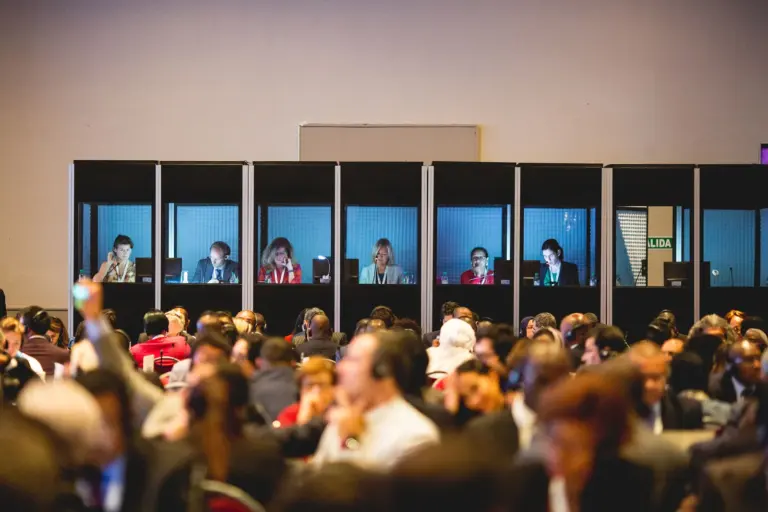
Simultaneous interpreting, where the interpreter speaks while the speaker is still talking, is harder work. For anything longer than about an hour, two interpreters share the job and take turns, which is the standard working practice for conference interpreters set out by AIIC, the international association of conference interpreters. That doubles the interpreting line, and a booth and headsets add an equipment line on top.
Whispered interpreting sits between the two: simultaneous, but spoken quietly to one or two listeners, with no equipment.
Where the Work Happens
Work inside Dhaka is the baseline. Outside Dhaka, the interpreter’s time on the road is charged at half the hourly rate, and travel, accommodation and meals are added. We list those on separate lines so you can see the interpreting price and the travel cost apart. Regular destinations include Cox’s Bazar, Sylhet, Chattogram and the Chittagong Hill Tracts.
How Long the Job Runs
Hourly rates suit short jobs. For a full day or a multi-day assignment, a day or engagement price is usually cleaner and works out better for you than counting hours. Longer deployments with a field team are quoted as one engagement.
The Subject
A factory audit, a court-related interview, a medical mission or a trauma-informed interview needs preparation: reading, terminology, names and a briefing. Specialised or sensitive subjects sit higher in the range because that preparation is part of the job.
Languages
Bangla and English is our core pair. French, Spanish, Chinese and Arabic are interpreted directly to and from Bangla, and the languages page lists each pair. Rarer pairs and regional varieties such as Sylheti or Chittagonian can change the price or the plan, so name them in the brief.
Notice
A booking made a week or more ahead is the easiest to price. Same-day or next-day work is often possible, but a booking made less than 24 hours ahead is charged at the top of the range. Work on Fridays and public holidays carries a 25% surcharge, and during the Eid holidays 50%.
What a Fair Quote Should Show
A good quote lets you see exactly what you are paying for. Before you accept one, check that it shows:
- The interpreting time, by hour, day or engagement, and what counts as a day
- How many interpreters, and why, if there is more than one
- Travel, accommodation and meals on their own lines, if the work is outside Dhaka
- Any equipment, such as booths, headsets or a portable system, on its own line
- Preparation, if the subject needs it
- What happens if the schedule runs over, and the cancellation terms
- Confidentiality, and whether the interpreter will sign your NDA
Every quote from us is itemised in writing, with travel and equipment listed separately. You can request one here; a person replies within 24 hours.
Sample Budgets
These examples show how the factors combine. They are illustrations, not quotes: your own date, place and subject decide the final figure.
| Job | Likely shape of the quote |
|---|---|
| Two-hour supplier meeting in Gulshan | Consecutive, one interpreter, hours at the lower end of the range |
| Full day of factory visits in Gazipur | Consecutive, one interpreter, a day price plus transport |
| Three days of field interviews in Cox’s Bazar | One interpreter, an engagement price plus travel, accommodation and meals |
| One-day conference in Dhaka with two languages | Simultaneous, two interpreters, plus booth and headsets |
| One-hour video call across time zones | Remote consecutive, hours, no travel |
For calls and short sessions, remote interpreting by Zoom, Teams, Google Meet or phone removes travel from the bill altogether.
Why Rates Differ Between Interpreters
A lower hourly figure is not always the cheaper choice. The difference usually sits in what surrounds the interpreting:
- Preparation. Reading up on the subject and the names involved before the day.
- Accountability. A named, briefed interpreter, and someone responsible for the result if plans change.
- Confidentiality. A signed NDA and clear rules on recordings and notes.
- Experience of the setting. Interviewing a source, working on a factory floor and interpreting a panel are different skills.
An inexperienced interpreter who summarises instead of interpreting can cost far more than the fee, in a misquoted source, a misunderstood contract term or a meeting that has to be repeated.
How to Keep the Cost Down
You can usually save without lowering quality:
- Send a clear brief. Date, place, languages, the kind of work and the subject. A precise brief means a precise quote, with nothing padded for uncertainty.
- Group the work. Several interviews in one place on one day cost less than the same interviews spread across a week.
- Choose the right mode. A small meeting rarely needs simultaneous equipment; consecutive or whispered interpreting may do the job.
- Use remote interpreting for short calls. No travel, no minimum day.
- Book early. Short notice narrows the choice of interpreter and can raise the price.
- Share material in advance. Agendas, slides, names and technical terms shorten preparation and improve accuracy.
Frequently Asked Questions
Do You Charge by the Hour or by the Day?
Both. Short jobs are charged by the hour, with a minimum of 2 hours on site or 1 hour remote; full days and multi-day assignments usually have a day or engagement price, which is simpler and often better value.
Is Travel Included in the Price?
Travel, accommodation and meals for work outside Dhaka are listed separately in the quote, so you can see the interpreting price on its own.
Why Does Simultaneous Interpreting Cost More?
It is more demanding work, and for sessions longer than about an hour two interpreters share it in turns. Booths and headsets are an extra line when the event needs them.
Can I Get a Quote the Same Day?
Simple bookings are often quoted the same day. A person replies to every request within 24 hours, with questions first if the brief leaves anything open.
Do You Interpret Into Languages Other Than English?
Yes. Bangla and English is the core pair, and French, Spanish, Chinese and Arabic are interpreted directly to and from Bangla.
Do You Need a Deposit?
Yes, for most bookings. A 50% advance confirms the booking, and new clients pay jobs of one day or less in full in advance. Organisations that pay on invoice can confirm with a purchase order instead. Travel, accommodation and equipment are paid before we book them.
What If We Need to Cancel or Change the Date?
Cancelling more than 7 days ahead costs nothing, apart from costs we cannot recover, such as non-refundable tickets. Closer to the date, a share of the fee applies, and you can move a booking once without charge with more than 72 hours’ notice. Our terms of service set out every case, including conferences, no-shows and hartals. We never charge interest or late payment fees.
Conclusion
Interpreter cost in Bangladesh comes down to a few clear factors: the mode, the place, the length, the subject, the languages and the notice. Our rates, from USD 25 to 100 an hour, USD 100 to 300 a half day and USD 200 to 600 a full day, cover most work, and an itemised written quote shows exactly where your job falls before you commit.
Send the date, the place, the languages and a line about the work, and we will tell you what it needs and what it costs.